

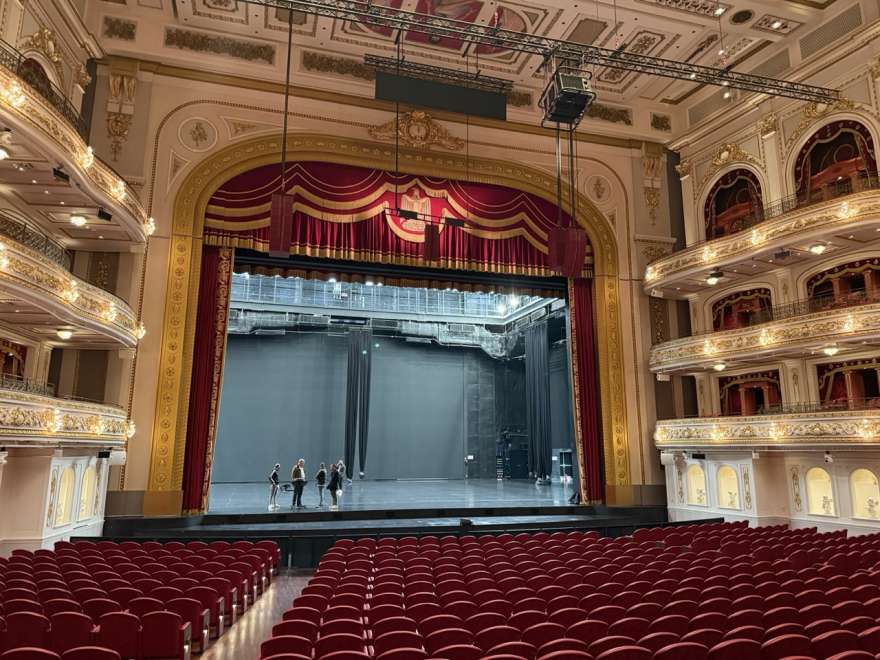
The New Capital Cairo Opera House brings together multiple performance venues within a City of Arts complex, with Audio Technology delivering professional audio and AV systems across the site
Conceived as a flagship development within Egypt’s New Administrative Capital, the New Capital Cairo Opera House represents a significant expansion of the country’s performing arts infrastructure. Rather than a single large auditorium like its counterpart in the main city, the project forms part of a broader City of Arts complex, incorporating multiple performance venues, rehearsal spaces, public circulation areas and supporting buildings designed to host a wide programme of cultural and entertainment activity.
For local systems integrator Audio Technology, the project combined two distinct but closely linked scopes of work: supplying, commissioning and tuning professional audio systems for the main performance venues, while also assuming responsibility for the design, installation and commissioning of AV systems throughout the non-auditorium spaces. In parallel, the company delivered an extensive stage engineering and machinery package in cooperation with German stage systems manufacturer Waagner-Biro.
The New Capital Cairo Opera House comprises three principal performance venues: the main concert hall, a drama theatre and an additional performance space, supported by rehearsal rooms and ancillary spaces. Beyond these, the wider complex includes public areas, outdoor zones and a mosque, all requiring integrated background audio and AV solutions aligned with the building’s architecture.
“The project was effectively divided into two parts,” explains Audio Technology systems designer Mario Abadeer. “For the main halls, we supplied the professional audio systems specified by the consultant and carried out commissioning and tuning. For the rest of the complex, our engineers were responsible for the complete AV design, installation and commissioning.”
Across the performance venues, L-Acoustics systems form the backbone of the sound reinforcement design. In the main concert hall, the system is built around dual main clusters, supported by SB18 subwoofers and a comprehensive deployment of X Series loudspeakers providing fill coverage across the audience areas. These include 5XT, X8 and X12 models, selected to address differing coverage requirements while maintaining tonal consistency throughout the space.
The drama theatre adopts a different approach, centred on a Syva-based system, again supplemented by X Series fills and a dedicated centre cluster to support spoken-word performance and theatrical production. Rehearsal rooms within the complex are also equipped with solutions from the French manufacturer, providing continuity between rehearsal and performance environments.
Amplification across the performance venues is handled via the LA4X platform. “Each space has a significant channel count,” says Abadeer. “That meant commissioning was a detailed process, checking every channel to ensure the correct presets were applied and that each loudspeaker was behaving exactly as intended.”
Wireless audio forms another key part of the system architecture, with Shure Axient Digital Wireless deployed across the performance spaces. The system supports a wide range of production requirements, from orchestral and theatrical use through to spoken-word events, while SM series microphones provide additional flexibility for performance and production workflows.
Commissioning the systems required detailed programming and verification. With early elements delivered during the Covid period, manufacturer travel was restricted, increasing reliance on local expertise. “Beyond loudspeaker alignment and tuning, the most time-consuming aspect was system programming and verification,” Abadeer explains. “Every signal path, amplifier channel and preset had to be checked. And as each room had a large number of channels, the process was extensive.”
Tuning focused on detailed measurements across audience areas, delay alignment and final optimisation for each space’s acoustic conditions. “We worked hard to tailor each system precisely to its environment,” Abadeer adds, “but, beyond the extensive procedure, we didn’t encounter any fundamental technical obstacles.”
While audio and AV systems formed a visible part of the integration scope, the scale of Audio Technology’s involvement also extended significantly into stage engineering. In cooperation with Waagner-Biro, the company delivered the stage engineering packages for the opera house, concert hall and drama theatre, including installation and after-sales services. The scope included orchestra pit elevators, seating wagon systems, adjustable proscenium elements and unified control and emergency stop systems.
In the main hall alone, up to 72 multipurpose fly bars were installed, with drive system winches arranged at grid level. Loudspeaker cluster hoists and over-stage lighting trusses were integrated within the wider machinery framework.
A substantial element of this work involved local steel fabrication. Audio Technology fabricated approximately 700 tonnes of welded steel construction and machined components in Egypt, while Waagner-Biro supplied motors and drive mechanisms. Installation was executed by Audio Technology under Waagner-Biro’s supervision.
The moveable seating towers, reaching heights of approximately 20m and weighing around 85 tonnes each, required precise mechanical and structural coordination to ensure stability and smooth electric drive operation. “Keeping the drive system columns vertical, particularly with column heights of around 9m, was extremely challenging,” Abadeer notes.
Across the non-auditorium spaces, Audio Technology was responsible for designing and integrating AV systems that balanced technical capability with day-to-day usability, particularly as the venue moved towards operation without a fully established in-house technical team.
“We became involved at an early stage, working alongside the consultant during the transition from conceptual design to equipment selection,” says Audio Technology’s AV spokesperson, Jacko Agaiby. “Each venue operates on standalone AV switching, which ensures full operational independence between spaces while maintaining consistent system behaviour across the wider site.”
Resilience and redundancy were approached pragmatically. “Redundancy was assessed based on application criticality,” Agaiby explains. “Additional layers were introduced where they offered genuine operational value, rather than complexity for its own sake.”
The extended project timeline also influenced technical decisions. Design and tender phases extended beyond 18 months, with architectural changes continuing throughout development. “Many adjustments were made after the design phase because of architectural changes,” notes Agaiby. “On long-term cultural projects like this, one of the biggest risks is misalignment between stakeholder timelines and shifting priorities.”
As the venue moved towards operation, Audio Technology remained closely involved. With no permanent in-house technical team initially in place, the company provided hands-on support during early events and performances. “That ensured continuity as the venue came online,” says Abadeer. “Later training was delivered in a cascaded format, tailored to different stakeholders based on their operational responsibilities. This allowed the teams to build confidence progressively.”
According to the team, only minor refinements were required following handover, primarily to fine-tune workflows once systems began to be used under live production conditions. Feedback from early use has been positive, with operators reporting smooth operation across both performance and public spaces.
Looking back, both Abadeer and Agaiby describe the project as a defining milestone. “It stands among the most significant large-scale venues we’ve delivered locally,” Abadeer reflects.
For Audio Technology, the New Capital Cairo Opera House reinforces the importance of end-to-end responsibility and local support. “Local sustainment capability was critical to protecting the integrity of the systems over time,” says Agaiby. “The project demonstrates what can be achieved when precision, partnership and turnkey delivery come together at scale.”