

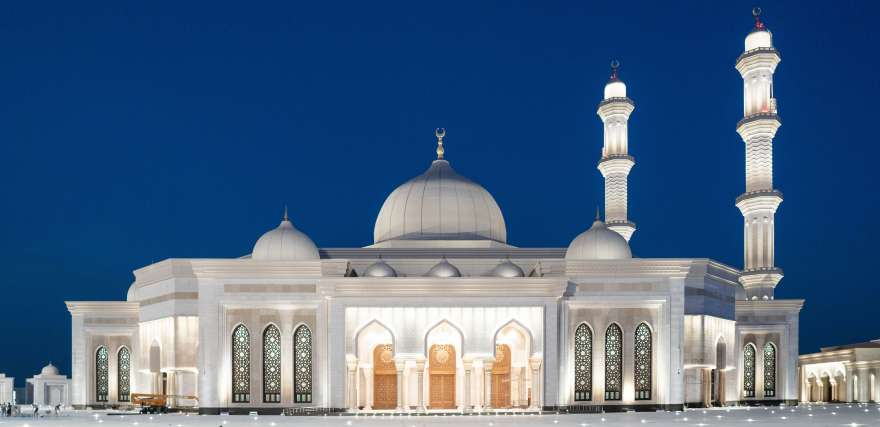
Audio Technology has installed Holoplot X1 arrays into Masjid Misr, the first time beamforming speakers have featured in a major house of worship
As Cairo has been gradually expanding East with the development of the New Administrative Capital on its outskirts, a number of grand buildings have begun to occupy the new skyline.
Serving as the Egypt’s Islamic Centre in the new capital, Misr Masjid takes this grandeur to entirely new levels. One of the largest mosques in Africa, the 19,100m2 complex houses a 9,600m2 mosque nave that can accommodate 12,000 worshippers, three separate domed entrances (as well as a fourth used purely for services) and a 60m-high main dome spanning a diameter of 29.5m. While aesthetically pleasing, the very high ceilings combined with marbled floor and walls create a cacophony of audio issues. Typically, this would be solved with a distributed speaker system, yet that approach introduces its own set of challenges.
Hoping to avoid all this, systems integrator Audio Technology opted to go in a new direction, installing Holoplot X1 arrays for the first time in a major house of worship. Instead of hundreds of compact loudspeakers littering the building, Audio Technology, working closely with the German manufacturer, has managed to cover all of the necessary areas with just nine discreetly placed X1 arrays – six positioned on the front wall, two on the dome base and one to cover the rear. This is a 70% reduction in speaker positions compared to the more conventional solution.
Geometrically, the building is basically a room within a room, effectively creating corridors around the perimeter of the central worship area that span 93m in length and 18m in width. X1s 3D audio beamforming capabilities allow for sound to be contained within defined zones which enable the creation of ‘sound corridors’ extending up to 100m in length with minimal spillage – perfectly suited for the mosque’s long corridors. To optimise intelligibility further, all areas not regarded as listening areas or areas that could cause reflections are designated as avoidance zones within the Holoplot design software. Two 4x2 X1 arrays situated on the far left and right-hand side of the building create the coverage corridors without any drop in level over 93m-long distance.
Positioned further inwards on either side of the entrance, the frontal system consists of X1 arrays in 3x1 and 2x1 configurations. This element covers the frontal congregation space, with tailored beams to avoid the mihrab and minbar. The first wavefront draws localisation to the front wall, avoiding feedback and interference echoes. A further two X1 arrays in a 2x2 configuration fixed at the dome base provide coverage for the audience area underneath, while one concealed in the ceiling covers the rear. Despite mounting positions of 23m up, the arrays are still able to achieve a high direct-reverberant ratio and speech intelligibility.
The installed system had to handle an existing reverberation time of 6s, caused by both the marble interior and massive dome. But by managing to not excite the reverberant field – directing energy away from reflective surfaces and preventing the need for large amounts of acoustic treatment – the teams were able to deliver an STI of between 0.5 and 0.7298 to 98% of standing and kneeling positions, each targeted area being served by at least one speaker module.
“There were a lot of ideas explored inside Misr Masjid that were entirely new,” recalls Holoplot’s Emad Elsaghir, who worked closely with the Audio Technology team both remotely during the design stages and physically on-site for commissioning. “It’s not only new technology, but a new way of implementing that technology in such a venue. In my opinion, it creates a new concept for worship houses in general. As part of our go-to market campaign for the X1s, we approached the project consultants and introduced the technology and the advantages that it offers, not for this project specifically. They were impressed, and when they became involved with the mosque, were very keen to explore this approach further.
“Our solution is very different from typical cases, where the classical technologies and products and methodologies are already well-established. So, we provided them with extensive evidence of our approach through data simulations. It was an incredibly detailed study that considered all factors. It showed that the proposed solution could solve all of the issues raised by the stakeholders, including the architect who of course played a major role. The interior of the room is a masterpiece and they wanted to keep it intact.”
In order to physically conceal the X1 modules, specially crafted metal screens and painted cloth were used that were acoustically transparent while ensuring the speakers are invisible to worshippers. “The ability to control sound in both the horizonal and vertical plane means that we can go as high with the installation as we wish, way higher than a line array which are limited to close to ear height,” notes Elsaghir.” By placing the arrays high up, we could reduce the amount of changes made to the marbled walls and ceiling, the pillars, the ornaments, the scripts and everything that you have inside the room. We can minimise change by minimising the amount of acoustic treatment needed. This was a very important incentive for the architect.”
Emad Shenouda, projects director at Audio Technology, sums up the team’s experience working with X1. “I’m pleased to say that together with Holoplot, we met the client’s brief of creating a fully integrated system that satisfies all stakeholders. The project was full of challenges, starting from the size of the mosque, the room acoustics and of course project deadlines. Thanks to X1’s ability to not only control sound in the vertical but also horizontal it achieves unbelievable intelligibility, thought impossible in a space clad in marble and featuring a huge dome at its centre. Holoplot exceeded our expectations in both the quality of sound and in hiding the equipment in such a way that it blends in seamlessly with the interior.”
A pair of X1 arrays flanking the main entrance
“The Audio Technology is highly capable and despite it being their first Holoplot project, I was impressed at how fast they made themselves familiar with the system,” concludes Elsaghir. “I conducted some training sessions with them remotely – the early stages of the project were happening during Covid times – and although the arrays were installed in very tight and awkward positions, they were able to install everything quickly, neatly and in harmony with our instructions. The interior designers were always changing and negotiated everything very professionally.”
Despite Elsaghir assessment that the Holoplot solution sets a new path for houses of worship, not all worshippers are blessed with Africa’s biggest mosque in their backyard. The company, however, has just realised unveiled its smaller X2 array which brings the same beamforming capabilities in a smaller format.
“The ability to hide the arrays inside the walls, the high ceilings, marble throughout and generally size of the mosque made it ideal for X1. In smaller rooms, I would say X1 is still a good choice depending on the specific case and the available space. But now we have the X2 and it is the perfect option for smaller houses of worship. It has the same features and is optimised for speech applications. The smaller form-factor means it can integrate much more easily into everyday interior design.”